
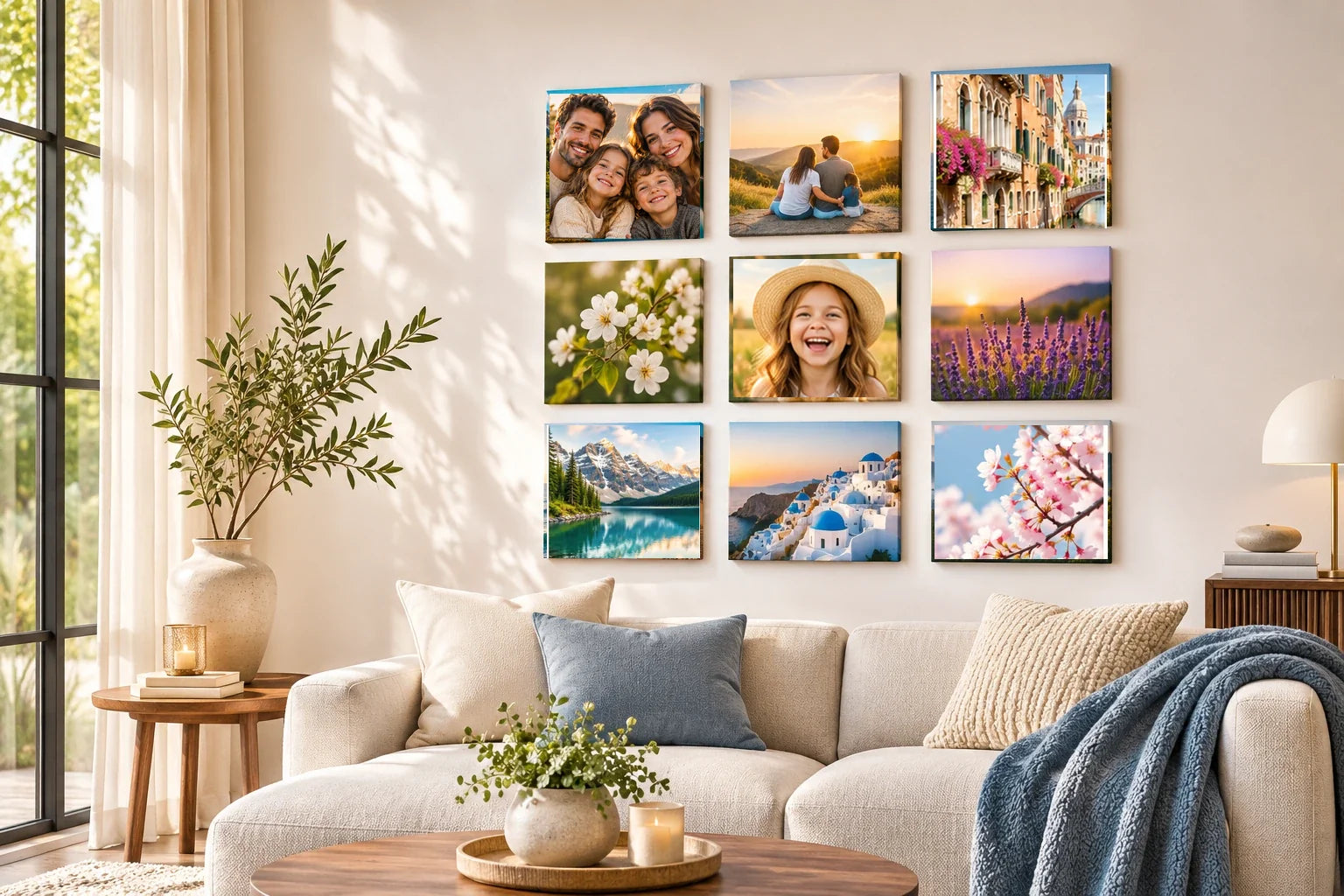
Bedrooms sometimes become places where relatives gather briefly during a celebration, visit, or busy family day. A photograph may capture a genuine smile or warm conversation while also showing an open drawer, private notebook, medication package, or personal messages in the background. Those incidental details were not the event's subject, yet a wall display can make them visible repeatedly. A careful bedroom gallery should preserve the human memory without turning someone else's belongings into an unwanted story.
Imagine two cousins talking in a room while relatives prepare for a celebration elsewhere. The source photograph includes a personal letter on the desk and a mirror revealing items on a shelf. The memory the resident values is the cousins' interaction, not the private contents of the room. A digital photo-tile proof can help compare an authentic alternative frame or a restrained crop while keeping the original record intact. The editorial choice should not depend on assuming tiny text will be hidden by an unverified final print size.
Identify the actual gathering and who controlled the room
Before selecting the photograph, confirm where and when it was made and whether the room belonged to the resident or another person. A bedroom may have been borrowed for preparations, used by guests, or photographed during an unexpected visit. The people in the source may remember the conversation but not every object visible around them. Record the occasion accurately without implying that all participants lived in that room or owned its belongings.
Privacy expectations can differ across spaces. A relative might agree to a group photograph in the living room yet have no reason to expect the contents of their bedroom to appear in a future display. Ask appropriate people about use of the specific frame. The fact that a photographer was invited into the room does not automatically make every background item available for reproduction. Treat the human event and the private setting as separate considerations.
Inspect backgrounds, reflections, and incidental text
Review the full-resolution source where appropriately authorized, paying attention to surfaces beyond the central faces. A calendar, badge, prescription label, open screen, address, or handwritten note may be visible. Mirrors can reveal parts of the room not obvious in the main view. A screenshot of the image could expose that information if circulated to reviewers. Do not rely on the assumption that small details will remain unreadable; screen enlargement and print output are separate matters.
Make a private inventory of what should not be shown, using minimal description rather than copying the sensitive information into the planning notes. The editor needs to know that a confidential item is present, not reproduce its contents. If the source contains material belonging to a person outside the intended photo audience, consider an alternative authentic frame from the same gathering. Protecting the background can be more important than preserving the most flattering expression.
Choose source alternatives before altering the record
A second photograph from the same occasion may show the cousins with a different background. Compare it with the original and ask whether it preserves the relationship or event clearly enough. Using another genuine exposure may avoid unnecessary editing and maintain the source's integrity. If only one photograph survives, consider a restrained derivative that omits a sensitive corner without removing relevant participants or changing the meaning of their interaction.
Do not digitally replace the room with a perfect generic bedroom while presenting the result as an authentic memory. That would manufacture a location and could hide details that explain the event. A source-faithful crop may be appropriate when its limitations are recorded, but it should not create a false impression that someone was alone or that the group met elsewhere. Keep the untouched archival master separate from any privacy-screened working version.
A bedroom gathering scene may look harmless until a closer inspection shows medication, a personal letter or another person's possessions on a bedside table. Check the entire original, then review the proposed crop separately: a tighter frame can sometimes magnify a sensitive detail instead of hiding it. Compare a different authentic photograph of the same interaction before attempting extensive digital removal. If another person's belongings define the scene, ask whether that person is comfortable with the use. The goal is to remember the visitors without turning a private room into a source of unintended disclosure.
Preserve people and interaction despite a privacy crop
A close crop can make a portrait visually stronger while excluding the hands or surroundings that reveal why two people were together. Ask whether the chosen derivative still communicates the real scene. If a person is removed, the picture may appear to show a private interaction rather than a larger group. That change could be misleading even when the intention was simply to hide a document behind them. Reconsider the source selection rather than treating any crop as neutral.
The resident may value the bedroom gathering because of a small gesture or shared activity, not the surrounding possessions. A different source showing that gesture may be more useful than an aggressively modified image. A family archive does not need to provide a perfect photo for every memory. A meaningful moment can be remembered privately even when no display-safe image exists.
Review consent and photographic rights separately
People pictured may have different expectations about a photograph taken in a personal room. A candid could be affectionate to one relative and uncomfortable to another. Where appropriate, show the specific proposed image and intended audience before reproduction. Children, guests, and people in vulnerable situations require particular care. The image may remain valuable in a private collection even if its display is declined.
Photographer copyright is separate from the room owner's privacy and the subjects' comfort. A person who took the picture may have rights in the photograph, while background documents can implicate other people's information. Keep source attribution and permission status explicit. Do not assume the image is cleared because a relative shared it or because the final product would be located in a bedroom.
Make the gathering—not the belongings—the lasting memory
Save the selected frame, the original source reference, and the reason a privacy-safe alternative or crop was chosen. Avoid recording the sensitive details themselves in widely shared tracker fields. The conceptual photo group should remain unpublished and technically hypothetical: no product dimension, print clarity, wall suitability, or mounting method is established by a screen rendering.
A bedroom gathering photograph can preserve a real moment of closeness without exposing the room's private contents. The strongest editorial choice keeps the people and event recognizable while respecting the boundaries of the person whose belongings appeared incidentally. An honest source alternative or carefully documented derivative can protect that balance more effectively than a beautiful but revealing image displayed without review.
If several relatives remember the same gathering, invite them to describe the interaction rather than to scrutinize the private objects in the photograph. Their recollections can help choose a meaningful frame without turning another person's possessions into evidence. Keep those notes separate from any design file that a broader audience may receive.