
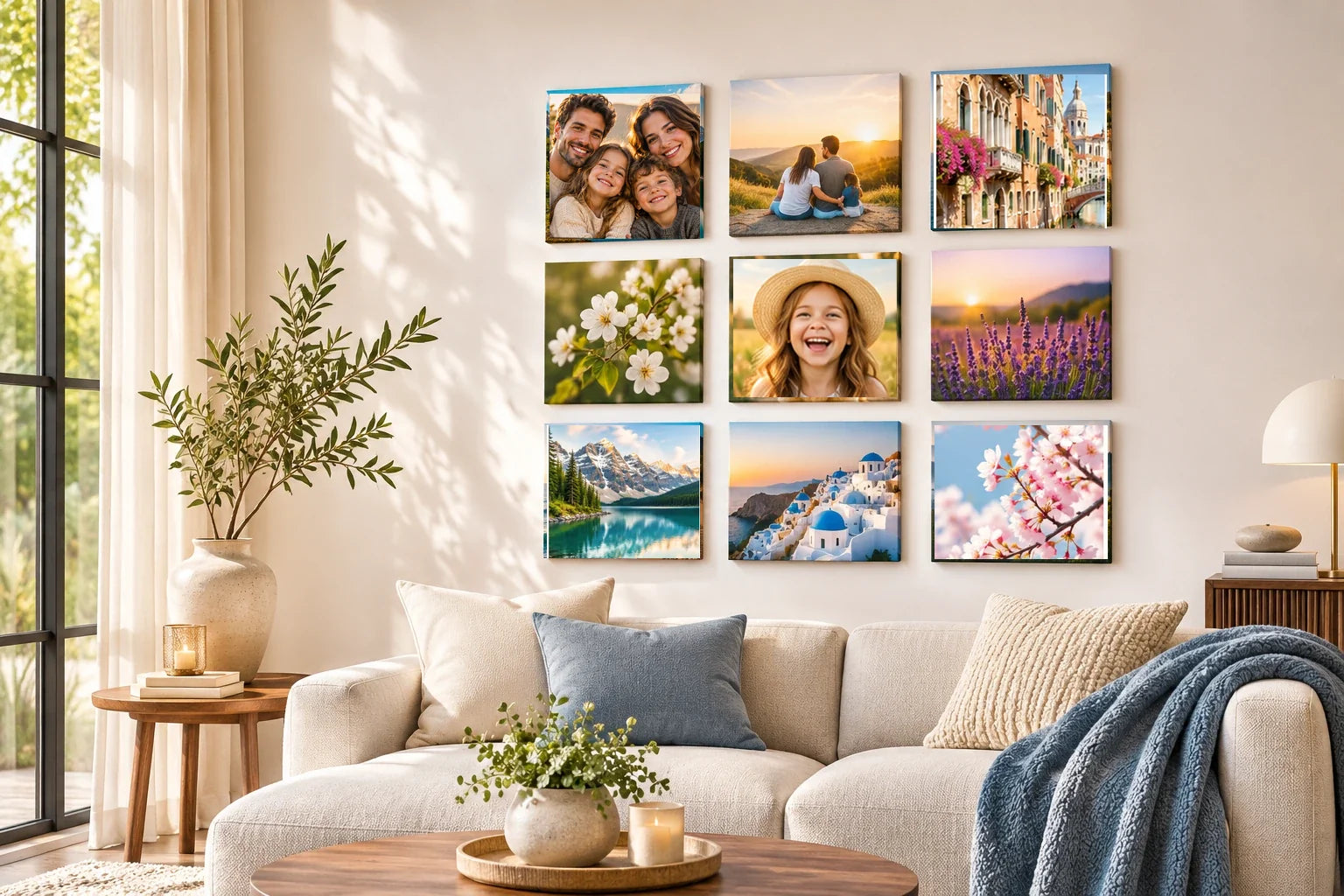
A living room with tall houseplants, trailing leaves, and small pots already has movement, texture, and color. Personal photographs can belong naturally in that environment, but a busy image collection may disappear among the foliage or make the room look staged for a decorating catalog. A family gallery should begin with people and memories rather than trying to imitate each plant. A digital preview can help compare visual relationships without proving that a particular photo product tolerates moisture, watering, sunlight, or any nearby growing condition.
Imagine a household with a large plant beside a sofa and family photographs from gardening afternoons, holidays, and ordinary weekends. The plants in the room may be part of family history, yet not every photograph needs a botanical subject. A close portrait can remain meaningful against green surroundings, while a real garden scene might connect naturally to a relative's interests. The aim is to choose honest, recognizable memories and give them room to be noticed as foliage grows and the household rearranges everyday objects.
Understand what the plants contribute visually
Look at the room from the sofa, doorway, and another place where people regularly sit. A broad-leaved plant may make one corner visually dense while a delicate trailing plant creates smaller repeated shapes elsewhere. The foliage can shift with seasons, light, and routine care. Note those changes as context rather than measuring a permanent arrangement around today's exact leaf positions. The photographs should make sense when the plant grows or moves, so avoid basing an entire composition on a fleeting silhouette.
A digital room photograph can reveal when family faces are visually crowded by nearby leaves or patterned pots. A portrait with a detailed background may compete with a dense plant more than a quieter picture would. That is a selection observation, not a rule that all rooms need plain portraits. Test the original sources before changing their colors. Authentic pictures of relatives at a garden party may be lively and still work in the room when given a distinct narrative role.
Choose memories that have a genuine reason to be here
A gardening photograph may have special relevance if someone in the household tends the plants or remembers working with an older relative. Use that connection when the source supports it. Do not claim that a generic green landscape records the family garden simply because it matches the leaves in the room. A photograph of the actual person, occasion, or familiar place may make the gallery more personal than a perfectly coordinated botanical composition whose subjects have no connection to the household.
Consider including pictures that are not about plants. A family portrait, an outing, or a small celebration can introduce varied human experiences into a leafy living room. Ask what each photograph communicates without the decorative surroundings. If the image would mean little after the pots and cushions changed, it may have been chosen primarily for color. A thoughtful selection survives changes in decor because its value comes from the people and events it truthfully represents.
Keep faces and important context readable in the mockup
Create two conceptual arrangements from the same approved photograph set. In one, the most detailed family images sit near the densest plant forms; in the other, a calmer portrait or more open scene occupies that area. Compare which version helps viewers recognize people without removing natural details from the source. A wide gathering picture might contain several relationships worth preserving. Do not crop away relatives merely to create a blank area that coordinates with foliage.
In a plant-filled room, a leafy shelf may compete visually with a wide family picnic photograph. Try pairing the picnic with a clearer close portrait of someone from the same outing and compare how both read against the existing foliage. A subtle repeated green color is not evidence that the photos belong in that room, and plants may later grow or move. Choose images that remain meaningful even when the visual backdrop changes, leaving any actual wall and product questions unresolved.
At a smaller digital preview size, notice whether the family group reads as a distinct visual chapter rather than another patch of texture. Then inspect the photographs more closely to make sure meaningful expressions and context remain present. This does not predict final print legibility or establish any required tile dimensions. If a source is too complex for the proposed role, choose a different authentic image or simplify the surrounding group rather than making unsupported output claims.
Do not turn the plant setting into a physical-installation claim
Plant pots, watering routines, windows, and nearby surfaces can introduce physical conditions that a screenshot cannot evaluate. A pleasant-looking preview is not evidence that an adhesive, material, finish, or wall surface will tolerate moisture or any other exposure. Leave those questions explicitly unresolved until actual product instructions and the real setting can be checked. This article concerns a digital arrangement and family image selection, not where someone should mount an item safely beside a plant.
A household may also move plants while cleaning or change the furniture layout. The image-selection plan should remain flexible rather than dictating an exact relationship between a pot and a hypothetical tile. Record which photographic group needs visual separation from foliage, but do not convert that into centimeter measurements or installation clearance. A useful mockup conveys intent while remaining honest that physical feasibility, vendor options, and durability have not been demonstrated.
Preserve a natural family story instead of matching every green tone
Different photographs may contain cool outdoor light, warm indoor skin tones, and bright celebratory colors. Applying a universal green cast to make them harmonize with the plants can change what the photographs actually record. Keep the original image files and evaluate any derivative against them. A family's garden may be vivid in one photograph and subdued in another because the occasions occurred under different conditions. Those differences can be part of the story rather than flaws to correct.
Ask whether repeated botanical images are beginning to push out people who matter. A gallery intended to celebrate grandparents and children should not become a catalog of leaf patterns simply because the room has many plants. One authentic gardening scene may provide enough thematic connection. Use the remaining positions for portraits, shared activities, or places that the household values. Visual balance is stronger when it protects narrative diversity instead of repeating a decorative motif without purpose.
Review a layout that remains meaningful as the room changes
Show the conceptual group to people who use the living room and ask which photographs they notice and why. Their answers may reveal that a quieter image is especially meaningful or that an attractive garden picture belongs to a different branch of the family's history. Record corrections about identity, date, and permission. Photographer rights and depicted-person comfort must still be addressed independently before reproduction, even when an image feels especially appropriate in the current room.
A plant-filled living room can frame a welcoming family gallery without dictating its subject matter. The strongest proof gives photographs an authentic purpose, keeps faces recognizable, and treats changing foliage as part of everyday life rather than a technical specification. It does not promise that a tile can tolerate watering or a particular environment. When the people and memories remain central, the images can belong naturally alongside plants without becoming another layer of staged decoration.