
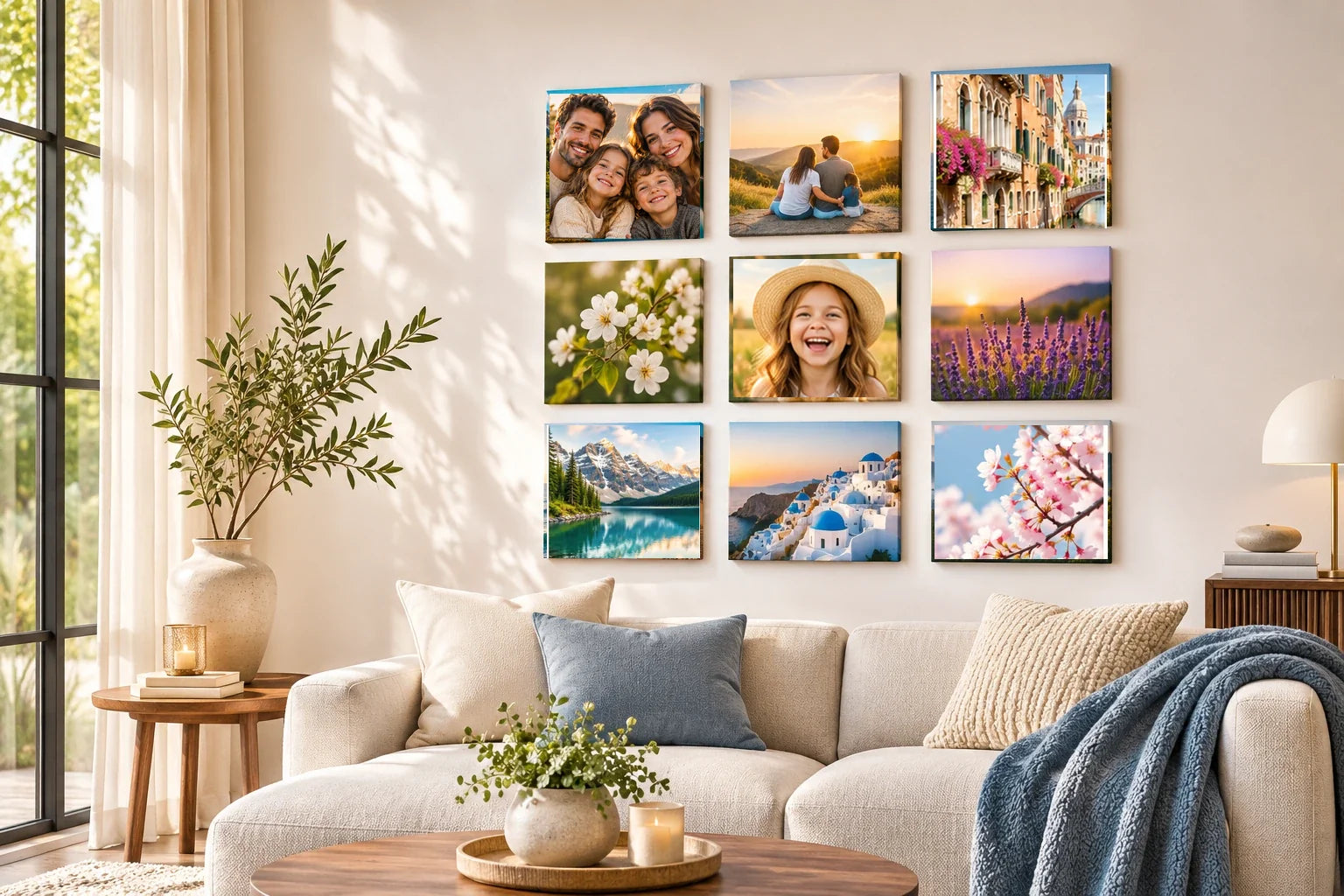
A multigenerational family archive can contain portraits from different decades, photographs of recurring celebrations and images made by relatives who never met one another. The temptation is to put everything into a strict left-to-right timeline, even when dates are uncertain or the story does not follow a straight line. A conceptual photo-tile mockup lets the household compare several ways of seeing those relationships before making any physical decision. The goal is to preserve what is known, not to create a neat historical narrative from incomplete evidence.
Use the same verified image set for several digital sequences and identify what each one is trying to communicate. One may follow broad decades, another may group shared activities across ages, and a third may place current and older photographs in conversation. These are editorial arrangements rather than new website features or product configurations. A good comparison considers who is represented, what relationships are implied and whether people can recognize the family story without an invented sense of progress.
Separate known chronology from remembered associations
Begin with a private working inventory that records who appears in each photo, what event it shows and how certain its date is. A caption written years after an event may be useful but should not override visible evidence or a reliable family record. Mark uncertain dates as approximate rather than assigning false precision. A picture of an older relative as a child might belong before a later wedding portrait, but a photograph of cousins whose birth years overlap could sit in several places without establishing an exact order.
Look for associations that are meaningful even without perfect dating. Two generations photographed in the same garden may reveal continuity of place; a grandmother teaching a skill and a grandchild practicing it much later may support a thematic pairing. These connections should be grounded in the people and activities actually shown. Do not imply that the older photograph caused the newer event or that every family member followed the same life path. A layout can celebrate resemblance without converting resemblance into genealogy or destiny.
Build a chronology-first digital version
For the first proof, organize images into broad, supportable periods rather than a continuous parade of exact dates. A small group of archival photographs may introduce an earlier decade, followed by pictures from the middle years and then a more recent chapter. Where dates are unknown, keep the images near related scenes without assigning them to a specific year. This version tests whether the household benefits from seeing change over time and whether the transitions make sense to a viewer unfamiliar with the archive.
Check whether chronology accidentally excludes people who entered the household later through friendship, remarriage, adoption or other relationships. A strict generational ladder can suggest that some connections are less legitimate simply because they do not follow one genealogical line. The mockup can instead include a shared event that shows the actual network at a particular time. Ask whether a family newcomer is being treated as a footnote or a full participant. Revise the sequence before it becomes a permanent visual assumption.
Try a thematic arrangement across different ages
A second proof might group photographs by shared experiences rather than dates: music, cooking, travel, ordinary afternoons or recurring celebrations. A child playing an instrument can sit near an older relative doing something similar, even if the photographs were made decades apart. This is a thematic resemblance, not evidence that one person taught the other. The arrangement may help viewers recognize interests that cross generations while allowing each individual's experience to remain distinct.
Try two layouts using the same verified sources: one moves through dated family photographs, while another groups moments around cooking, play and shared places. The chronological version may reveal growth, but it could mislead when an old scan has only an approximate year. The thematic version can retain those meaningful photographs without pretending the dates are exact. Ask relatives which relationships become clearer in each arrangement and retain the source uncertainties in the project record.
Thematic groups can also expose gaps that chronology hides. If all travel pictures feature one branch of the household, a travel chapter may appear to represent the entire family when it does not. Make the selection transparent rather than inventing trips or adding unrelated scenery to complete a balanced pattern. One group may contain only two photographs because that is what the archive supports. The mockup should respect unequal documentation instead of manufacturing a falsely even history.
Test conversational pairings instead of a single line
In a third proof, place an older photograph beside a newer one that responds to it through expression, place or activity. A formal portrait beside a current candid can reveal both difference and affection. A childhood image of a parent may be compared with a later picture of their child without claiming the faces or lives are interchangeable. Use these pairings sparingly so the gallery does not imply that every person exists only as a reflection of an ancestor.
Consider the visual consequences of missing people or inaccessible images. A known family member may have no surviving portrait, and the gallery should not invent one or silently substitute someone else. An alternate pairing can use a genuine group scene or a place photograph when it reflects documented shared experience. The display remains a selective account, not an exhaustive family tree. Explain that limit in private production notes so future editors understand why some plausible pairings were not included.
Compare how each version treats identity and privacy
Show the three digital proofs to appropriate family reviewers without presenting them as finalized print placements. Ask which version reflects relationships accurately, which photos draw disproportionate attention and whether the order suggests unsupported claims about family roles. Pay special attention to living people who may have different wishes about an older photograph. A picture that is treasured privately is not automatically suitable for a household wall viewed by visitors, and permission to use it may require more than one person's agreement.
Verify source ownership separately from depicted-person comfort, particularly for studio portraits and photographs supplied by friends. An inherited paper print may not establish reproduction rights. Preserve the original image file and available photographer credit, and flag uncertain permissions for qualified review. Avoid revising a historical photograph to create missing resemblance or remove evidence of a complicated relationship. The comparison should reveal genuine visual options, not pressure people to approve a tidier or more flattering invented family story.
Choose the version that keeps uncertainty visible
Record what each arrangement did well: chronology may explain change, themes may reveal shared interests, and pairings may create intimacy between distant decades. A household might combine these principles, with one broad time chapter and a few carefully chosen cross-generational comparisons. Save the rationale alongside the digital proof. There is no need to freeze precise tile counts, gaps, hardware positions or product dimensions at this stage, because the exercise answers an editorial question rather than a physical installation problem.
A strong multigenerational layout helps people see their family history without flattening it. It allows an uncertain date to remain uncertain, a missing image to remain missing and each person's contribution to retain its own context. Choosing among several digital versions makes those tradeoffs easier to notice. When the household can explain why images belong together and what the arrangement does not claim, the gallery has a sound narrative foundation for any later, separately verified production decision.